
Media - Psychopompus
Text by Camilla Trussardi (excerpt)
..... Reflections, those with which it was intended to begin, that have sprung from an exploratory investigation into the meanings of the work Psychopompus, the latest pictorial creation by Francesco Galmarini, as well as from a comparison with the reading of authors who are points of reference for Galmarini himself in the formation of his pictorial identity: from the anthropologist Ernest Becker to the philosopher Peter Wessel Zapffe, passing through artists of the calibre of Arnold Böcklin, Ferdinand Keller and Caspar David Friedrich.
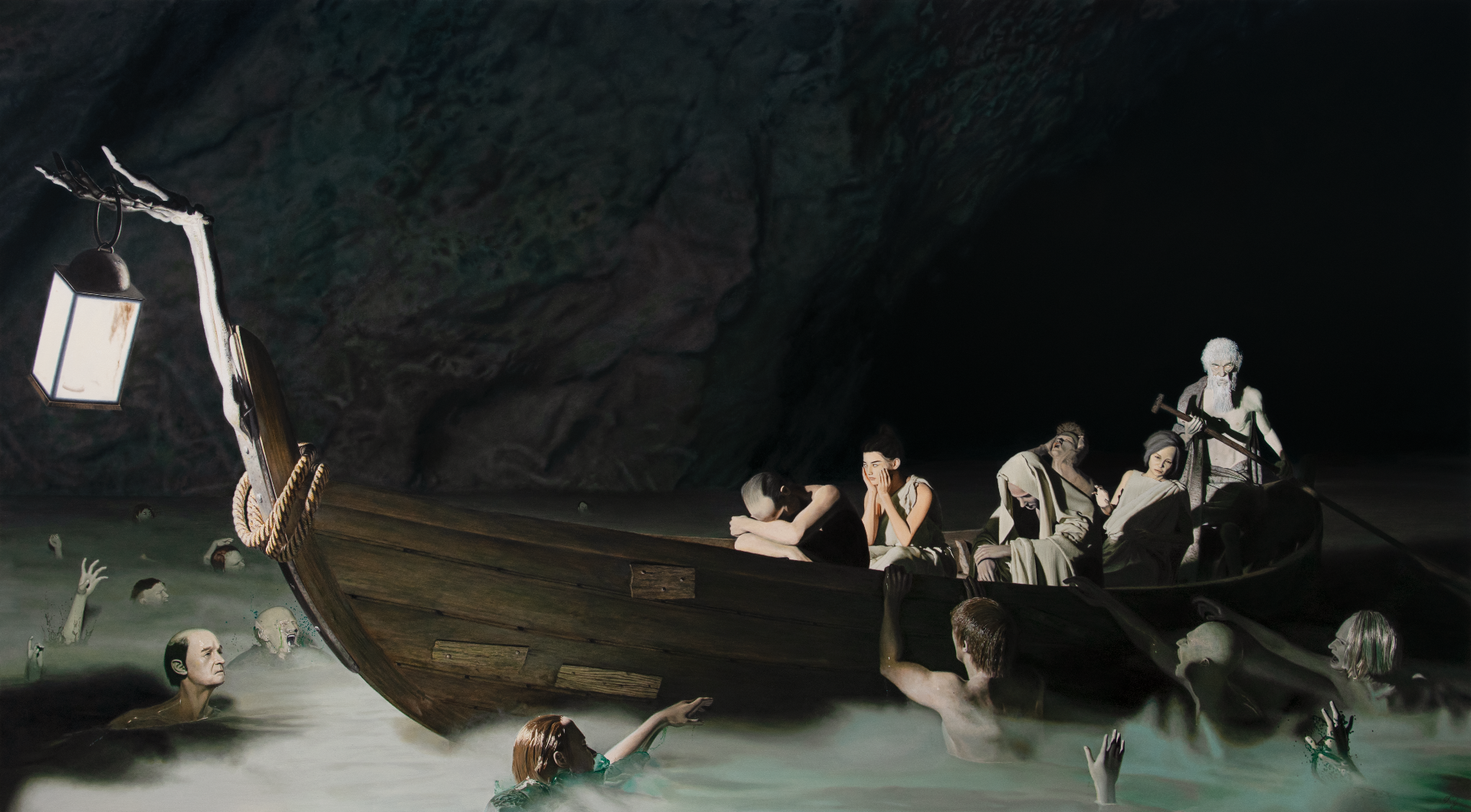
The aforementioned depiction offers a vision that is allegorically dense with mythopoietic references and archetypal suggestions, through the narration of the descent into Hades: the figure of the psychopomp is rendered in the likeness of Virgil’s ferryman, ashen in face, “with eyes like burning coals”, “whose broad white beard flows down upon his chin”.
And “a filthy cloak hangs in folds from his shoulders, knotted there”: a drapery almost sculpted, reminiscent of Schedoni.
“He gathers them all in”, the souls of those he ferries, and “strikes with his oar whoever lingers”.
Yet amid the suffering of those who, from the vessel or among the river’s currents, despair, consumed by the condition of nearness to eternal torment, there rises the figure of a young woman, the embodied emblem of surrender to the inevitable.
And not a surrender of passive resignation: by embracing the artist’s intention to suggest the possibility of a conscious reconciliation with the laws of nature, the inspirational matrix of the opening reflections now becomes clearer to the reader.
Let one further step then be taken: the work becomes an allegorical vehicle of Zapffe’s tragic vision, but observed through Becker’s lens.
In other words, Galmarini does not merely return to the viewer the image of a slumbering humanity that has renounced the burden of knowledge in order to escape the weight of the inescapable, but offers the alternative of a bitter antidote, namely the awareness of the absurd: the work of art points out, “with a precise finger, the dead-end road into which all advance”. .....
Dettagli dell'Opera